Sintered Metal Felt

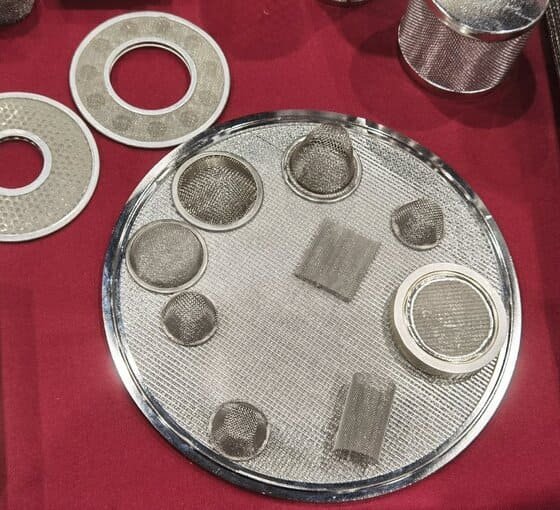
Sintered Metal Fiber Felt Filter Disc

The flat form of the sintered fiber felt element, cut to a disc and stacked into the pack — rated 0.5–50 μm.

  • 0.5 – 50 μm
  • Sintered metal fiber felt
  • up to ≤600 °C
Sintered metal fiber felt filter disc with welded support layer and flanged seating edge — placeholder 640x480, to be replaced with the real photograph

A sintered metal fiber felt disc rated 0.5–50 μm, cut flat and stacked into the housing. Contaminant is held through the depth of the felt wall, so the disc carries more before the differential pressure becomes the limit. Discs are cut, flanged and welded in house, then batch-tested for bubble point and air permeability. Service temperature holds to 600 °C.

The sintered metal fiber felt disc is the flat form of the element: a fiber mat sintered into a sheet, cut to a disc and stacked or clamped into the housing. It suits duties where the filtration area is set by the disc diameter and the number of discs, and where the element has to be taken apart, cleaned and put back. Ratings run from 0.5 to 50 μm, in liquid and gas service up to 600 °C.

Because the rated layer is a fiber mat and not a woven opening, contaminant is held through the depth of the wall. A disc holds more before the differential pressure becomes the limit than a comparable mesh disc, and it tolerates the repeated cleaning cycles that a stacked disc pack usually sees.

Discs are cut, flanged where the pack needs it, and welded to the support layers and connection detail in our own plant — TIG, resistance or laser welding on stainless, titanium and nickel alloys. Sintered fiber felt is bought in to specification; the forming, welding and testing are ours. Every batch is measured for bubble point and air permeability, and the record travels with the dispatch. Where the pack needs a support layer under the felt, or a flanged edge to seat the disc, both are welded before the disc leaves the shop.

Send a drawing, an OEM part number or a used disc and we confirm the equivalent from diameter, thickness, micron rating, alloy and the way the pack is held and sealed. Where the disc is designed from the duty instead, send temperature and peaks, medium and corrosives, working pressure and differential, contaminant and its size distribution, the rating with any bubble point or permeability target, flow and disc count per housing, and the geometry. Drawing review takes 3–5 working days, and the dimensioned drawing comes back for your approval before a price does.

Key Benefits

What this element buys you in service

  • 01

    Area set by the disc count

    Filtration area follows the disc diameter and how many discs the pack holds, so the element is sized to the housing instead of to a catalogue.

  • 02

    Depth filtration in a flat form

    The felt holds contaminant through the wall rather than on one surface, which is what a disc that is cleaned and re-stacked needs.

  • 03

    Re-stacked instead of replaced

    The pack comes apart, so single discs can be cleaned, inspected and put back, and a line cleans on its own schedule.

  • 04

    Hot service without polymer media

    The sintered fiber structure holds to 600 °C, past the point where paper and polymer discs stop being an option.

Construction

How the element is built

  1. Protective mesh

    A coarse woven mesh over the upstream face, protecting the felt through handling and cleaning.

  2. Sintered fiber felt — the rated layer

    Metal fiber sintered into a mat and cut to the disc diameter. The micron rating and the bubble point are measured against this layer.

  3. Support layer

    A coarser sintered layer downstream that carries the differential pressure, so the rated felt keeps its pore size in service.

  4. Edge and flange

    The disc edge is flanged or welded where the pack needs it to seat and seal — TIG, resistance or laser welding.

Protective meshSintered fiber feltfiltration layerSupport layersdrainage and strength
Section through the element wall Section through the element wall: a protective mesh over the sintered fiber felt, backed by the support layers that carry the differential pressure.

Specification

Technical specifications

The figures we publish for this element. Where a duty needs something outside them, the review says so before a price is given.

Filtration rating 0.5 – 50 μm
Media Sintered metal fiber felt
Form Disc · disc stack
Alloys 304 · 316L · 310S · FeCrAl · Hastelloy · Ti · Ni
Maximum service temperature up to ≤600 °C
End connection Discs stacked, clamped or welded into the pack; support layers and flanged edges welded in house
Cleaning method Washable and re-generable; cleaned in place or off-line
Batch test Bubble point and air permeability measured on every batch; the record travels with the dispatch
Structure Protective mesh · sintered fiber felt · support layer
Geometry Disc, cut to the diameter on the drawing
Edge Flanged or welded to seat in the disc pack
Testing Bubble point and air permeability on every batch

Materials

Alloys this element is built in

The alloy follows the medium, the temperature and what the element has to resist. Where a duty sits between two of them, an engineer says which one and why.

  • 304 stainless steel

    Standard industrial duty where the medium is not aggressive.

  • 316L stainless steel

    Where chlorides or acids are present in the medium.

  • 310S stainless steel

    Heat-resistant grade for continuous high-temperature service.

  • FeCrAl alloy

    Oxidation-resistant at temperature where stainless steel scales.

  • Hastelloy

    Nickel alloy for aggressive media where stainless is not enough.

  • Titanium

    Corrosive service and where high purity is required.

  • Nickel alloys

    Hot aggressive media where stainless stops being enough.

Industries

Where this element runs

The duties this element is bought for, and what it is filtering in each of them.

  • Chemical fiber and polymer

    Polymer melt and spin-line filtration where the disc pack is cleaned between campaigns.

  • Petrochemical

    Process stream filtration on small housings where the pack is taken apart for cleaning.

  • Semiconductor

    High-purity gas and chemical service with an element that can be cleaned and reused.

  • Pharmaceutical

    Batch filtration where the element is cleaned and the batch record travels with it.

The industries page sets each of these duties in place, with the systems it belongs to and the filter positions we are asked to quote in it

Customisation

Built to your drawing

Cut to your drawing: disc diameter, thickness, micron rating, alloy, edge treatment and how the disc seats in the pack all follow the housing or the OEM disc being replaced. Send a drawing, a part number or a used disc and we confirm the equivalent from dimensions, medium and connection before a price is given.

Send what you have — a drawing, a part number, a photograph of the element in place, or just the operating conditions. Nothing is quoted from a part number alone.

MOQ A few pieces to a few dozen
Sample lead time 20–30 days
Production lead time 30–60 days

Downloads

Datasheet, drawing and batch record

No document is published for this element yet. Ask for it and the engineering desk sends the drawing and the specification sheet — and, on a repeat order, the batch record with them.

Why Us

Tested before it ships, from a plant you can audit

Every element is welded and batch-tested in our own plant, and the batch record travels with the dispatch. About 70% of our work is a replacement for an element already in service, which is why a drawing or a used part is enough to start from.

  • ISO 9001 Quality system
  • 70 / 30 Replacement work to work designed from conditions
  • 30–40% Below the brand element it replaces
  • 3–5 days Drawing review before a quote

Questions

Questions this element raises

How is the number of discs in a pack decided?

The pack is sized to the flow the housing has to pass. Send the flow rate, the disc count per housing you run now and the housing envelope, and the disc diameter and count are set from those. The micron rating stays inside the 0.5–50 μm range of the felt.

Can you match the discs already in the pack?

Yes. Send the drawing, the OEM part number or a used disc and the equivalent is confirmed from diameter, thickness, rating, alloy and the way the disc seats and seals. Flange and edge details are matched to the pack rather than approximated.

Is a disc element cleaned the same way as a cartridge?

The felt is washable and re-generable in both forms. A disc pack has the advantage that it comes apart, so individual discs can be cleaned, inspected and re-stacked. Tell us the cleaning method the line uses and we say whether it suits the felt.

Which alloy should the discs be made in?

304 or 316L covers most industrial duty, 316L where chlorides or acids are present, titanium for corrosive or high-purity service, and nickel alloys where the medium is aggressive at temperature. Send the medium, its concentration and the operating temperature.

What are the lead times for a disc order?

Drawing review takes 3–5 working days, samples are made in 20–30 days and production runs take 30–60 days. The minimum order is a few pieces to a few dozen discs.

What is measured on a batch of discs?

Bubble point and air permeability are measured on every batch in our own testing lab and the record travels with the dispatch. We work to ISO 9001, so the figures the discs were accepted against are the figures you hold.

Send the drawing, or the duty.

A drawing, an OEM number or a used element is the fastest route to a quote. With only the process — temperature, medium, pressure, flow — our engineers select the medium and issue a drawing for approval before anything is sampled.

Replacement elements cost 30–40% less than the brand they replace · Samples ship in 20–30 days