Custom Design

From operating conditions to a drawing you can approve.

Sintered metal elements for duties no catalogue covers: high temperature, corrosive media, tight envelope, a connection that has to match a housing you already run. Send the process or send the drawing — either way an engineer reviews it before anything is quoted.

Two Starting Points

Your drawing, or your operating conditions

Most suppliers want one or the other. Both routes run through the same design office and the same shop floor.

  • You already have a drawing or a part number

    About 70% of our orders arrive this way. We confirm the equivalent from dimensions, medium and connection type, replicate the weld configuration, and match performance on your own line.

  • You only have the operating conditions

    About 30% of our work starts with no drawing at all. You describe the duty, we send the questionnaire below, select the medium and structure, and issue a drawing for your approval before any material is committed.

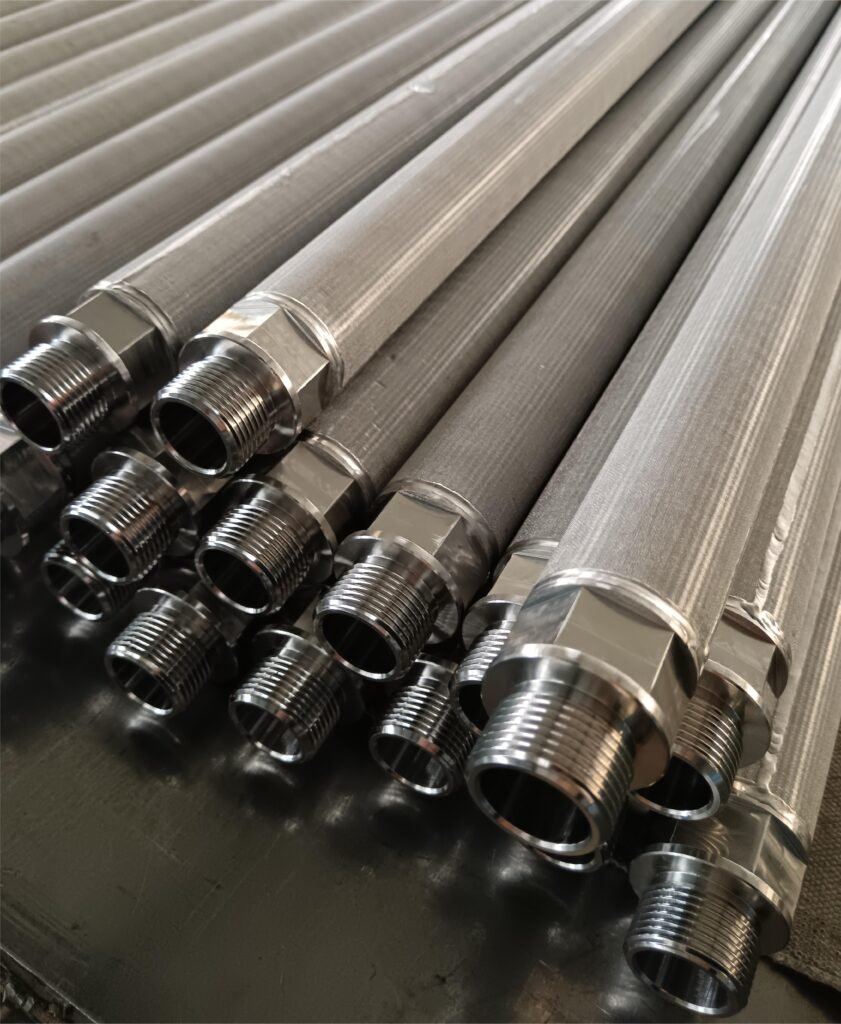
Custom-designed sintered metal filtration elements

15

Application Engineers

Turning process data and OEM part numbers into drawings, tolerances and weld details

3–5 days

Drawing Review

Feasibility, media selection and a dimensioned drawing for your approval

20–30 days

Sample Lead Time

A few pieces, tested on your own line before mass production

30–60 days

Production Runs

Batch bubble-point and permeability records shipped with the goods

What We Need From You

Seven inputs decide the design

This is the worksheet we send when a customer knows the process but not the medium. Send these and the feasibility review comes back in 3–5 working days; nothing is quoted before it does.

Input What to send What we do with it
Operating temperature Continuous and peak temperature, plus any steam, CIP or bake-out cycle the element sees. We use it to select the alloy and to set the weave, media and welding route.
Medium & corrosion What flows through the line, at what concentration, and which acids, solvents or HF-bearing streams are present. We use it to choose between 304 / 316L, titanium and nickel alloys, and to decide on surface treatment.
Pressure & differential pressure Working pressure, and the differential pressure the element carries in service. We use it to size the support layers and the end-cap weld configuration.
Contaminant & particle size distribution A particle size distribution if you have one; otherwise the contaminant itself and where it enters the line. We use it to fix the pore size and the number of filtration layers.
Required rating Nominal or absolute micron rating, and bubble point or air permeability targets where the duty is critical. This becomes the figure every batch is tested against before it ships.
Flow rate & duty Flow per element, and whether the line runs continuously or in batches. We use it to set the filtration area and the pleat or cylinder geometry.
Drawing, part number or sample A fabrication drawing or OEM number if you have one. If not, a spent element we can measure ourselves. It gives us the envelope dimensions, the connections and the performance baseline to match.

Design Capability

Engineering that owns the element end to end

One factory, one team, one quality system. The people who select the medium are the people who sign off the drawing and the batch inspection record.

Media & structure

Material selection first

Application engineers match alloy, pore size and layer structure to your temperature, pressure and corrosion data before anything is drawn.

Alloys 304 / 316L · Ti · Ni alloys
Media Sintered felt / wire mesh
Pore range 0.5 – 200 μm

Drawing

A drawing you can approve

You receive a dimensioned fabrication drawing with the tolerance stack-up and connection details, so deviations are caught on paper rather than on the shop floor.

Drawing review 3–5 working days
Approval Required before sampling
Confidentiality NDA on request

Sample & validation

Sampled on your own line

New customers are charged for the sample and we adjust until performance matches. Existing customers sample free of charge, because the drawing already exists.

Sample lead time 20–30 days
Sample quantity A few pieces
Sample charge New customers charged

From Conditions to Drawing

How a custom element gets built

The same five steps whether you start with a drawing or with a process description.

  1. 1

    Send the duty

    Operating conditions, a drawing or an OEM part number — whichever you have.

  2. 2

    Feasibility & media

    We confirm the element can be built, and in which alloy and medium. 3–5 working days.

  3. 3

    Drawing & quote

    A dimensioned drawing for approval, with price, MOQ, lead time and terms in one round.

  4. 4

    Sample

    A few pieces in 20–30 days, tested on your line before anything is produced in volume.

  5. 5

    Production

    30–60 day runs, with batch bubble-point and permeability records shipped alongside.

Material Selection

Two media routes, four alloy families

Which one your process needs is decided during the review, not by a catalogue page. Where a duty exceeds what these materials hold, we say so before quoting.

Route Pore range Form we quote
Sintered fiber felt 0.5 – 50 μm Pleated and cylindrical cartridges — washable and re-generable.
Sintered wire mesh 2 – 200 μm Rigid multi-layer tube, cone and disc for backwash and pulse-jet duty.
Special alloys on either route Set per duty Titanium, nickel alloys and Hastelloy for corrosive or high-purity service.

Every dispatch carries the batch bubble-point and air permeability records. ISO 9001 is the system certification we hold; anything beyond that — material certificates, project-specific certification — is confirmed per inquiry rather than assumed.

Sample & Lead Time

What a custom element costs you in time

Elements are consumables: most lines replace them every 3–12 months, and 60–80% of our revenue is repeat orders. That is the reason the sample stage exists — the first element has to be right before it becomes a scheduled part.

Drawing review 3–5 working days
Sample lead time 20–30 days
Sample quantity A few pieces
Sample charge New customers charged · existing free
Production lead time 30–60 days
MOQ A few pieces to a few dozen
Payment terms T/T — deposit, balance against B/L
First order cycle 1–3 months from first contact

Send the operating conditions, not the drawing.

Temperature, medium, pressure, contaminant and flow are enough to start. If you already have a drawing or an OEM part number, send that instead — it is the faster route to a quote.

Drawing review 3–5 working days · Samples ship in 20–30 days · Drawings handled under NDA